25 April 2016

A Homily on the Feast of Saint Mark


For the Feast of Saint Mark the Church chooses the command: “Go into the whole world and proclaim the Gospel to every creature.”  And for the Epistle she chooses the way how: “Clothe yourselves with humility in your dealings with one another…humble yourselves under the mighty hand of God…Cast all your worries upon him because he cares for you.”

And the truth is, my brothers, for everything that has been written about evangelization, new or old, it’s just that simple.

The effective apostle of the Gospel must clothe himself with humility, not just before God, but before everyone to whom he seeks to preach the truth.

Such humility is born in my relationship with God.  How can I possibly face the Creator of the universe than with a sense of my own littleness or the the one who hangs upon the Cross for love of me than with deep sorrow for my sins and my selfishness?

And in the effective preaching of such a Gospel I must maintain that same humility in imitation of the Word who was born in a manger and died on a cross.  As Pope Francis has said, “The style of evangelical preaching should be one of humility, service, charity and brotherly love [for] The Christian proclaims the Gospel with his life rather than his words.”  This do we carry the Gospel to others in the earthen vessels of our lives.

For the reality of all this humility, this sense that I am not in control, is that someone is in control, and that he cares for me as his adopted son, his beloved and his chosen.  Loves me as I am, ever ready to meet all of my needs.  He is the shepherd who leads me by still waters and refreshes my soul, the one who spreads a banquet before me and delivers me from the hands of my foes.


Which is why, as the final words of Mark’s Gospel predicts, I am humbled before the Lord and before every one to whom he sends me, to preach the Gospel by the manner of my life.

22 April 2016

Monsignor Hilgartner on Music in the Liturgy

Monsignor Richard Hilgartner, Pastor of of Saint Joseph’s Parish in the Archdiocese of Baltimore, and President of the National Association of Pastoral Musicians, addressed the Seminary community on Music in the Liturgy last evening in Saint John’s Chapel.  Monsignor is a former Executive Director of the USCCB Secretariat of Divine Worship.  During his time in the Liturgy Secretariat he presided over the publication and implementation of the new Roman Missal.  This great liturgist and pastor shared some wonderful insights with the Seminary community

During his talk he quoted from the USCCB’s guidelines on Music in Divine Worship, entitled Sing to the Lord:  
Participation must also be external, so that internal participation can be expressed and reinforced by actions, gestures, and bodily attitudes, and by the acclamations, responses, and singing. The quality of our participation in such sung praise comes less from our vocal ability than from the desire of our hearts to sing together of our love for God. Participation in the Sacred Liturgy both expresses and strengthens the faith that is in us.  (Sing to the Lord, no 13)

Monsignor Hilgartner went on to say: ”In other words, God gave you your voice and God deserves to hear it. That doesn't say anything about what the person sitting next to you might deserve to hear, but it does remind us that it is not so much the quality of our voice but the attempt to let our hearts sing, to sing to God what is welling up in our hearts.”

Fides Quaerens Intellectum

Father Romanus Cessario, O.P. preached this wonderful homily on the Feast of Saint Anselm just a few days ago.  It is provided here for your reading pleasure.

No seminary should neglect the optional memorial of Saint Anselm. To this monk, archbishop, and Doctor of the Church, seminaries owe their basic charter for operation. Fides quaerens intellectum. Each word is important. Everything that a seminarian does to contribute to his formation as a priest finds its mooring and its fulfillment in this phrase. True enough, Anselm considered “faith seeking understanding” a definition of theology. The Church, however, makes the expression a lesson for life. “St. Anselm,” writes Pope Saint John Paul II, “underscores the fact that the intellect must seek that which it loves.” (Fides et ratio, no. 42) Do you want to know what you love? Then acknowledge what your mind goes after. Saint Anselm helps us to see that every priest must be a theologian. Not in the professional sense, as in the university theologian, but in the original sense of one who holds firmly a word (logos) about God (theos).

First, Fides, faith. The man of faith assents to the truths that God reveals to his Church. Assent points to the personal act of faith, as when we say at the Baptismal liturgy, “Do you believe...? I do.” Faith also means the body of truths to which we must assent on God’s word precisely because truths of faith cannot be seen or demonstrated. The Catechism of the Catholic Churchcontains this body of truths. We speak about the Deposit of Faith. Priests must learn every number of the Catechism. True enough, there are many people who say, “Well, I do not accept this teaching and that teaching.” If the rejected teachings are those envisaged by the Profession of Faith that every cleric must take before ordination, then no Catholic and surely no priest can declassify and ignore them. That would be to sin against the First Commandment: incredulity.

Second, Quaerens, seeking. The truths of faith should make of those who believe them enquirers. About what does one enquire? The mysteries of faith: The Church, the Trinity, the Eucharist, the Priesthood itself... In other words, belief moves us to think, to ponder, to wrap our minds around the truth that we lovingly assent to. Coerced belief would show itself oxymoronic, a contradiction. Whom do we seek when we believe? The answer is simple: God. God whose truth we receive and God whose word we trust. Seeking is a movement of love, a going out of ourselves, an embrace. As the Canticle says, “On my bed at night I sought him whom my heart loves” (Sg 3:1).

Third, Intellectum, to be understood. Love is not blind. Love grows in proportion to the knowledge we enjoy of the beloved. Think of the differences in human friendships. The seminarian applies himself to his studies in order to love more the Word he must preach. Who can read Paul’s address at Antioch (see Acts 13:13-25) and think that he meant only to share a few experiences? He gives a reasoned account of Christ’s Davidic lineage. No captationes benevolentiaeotherwise known as attention getters for Paul. He motions with his hand. Who may reasonably deny that Paul loved that which he understood? In one sense, today’s priest faces a more difficult challenge than what Paul met. There is more to learn. More to ponder (materially). Should we say to ourselves, “I can get by with a few platitudes; after all, the parishioners do not know theology”? Not if we heed the lesson that Saint Anselm teaches. Not if we want to love that which we believe. Not if we want to avoid the calamitous circumstance that arises when our minds veer towards, embrace even, error. Then we risk hearing Christ say to us, “The one who ate my bread has raised his heel against me” (Jn 13:18).

19 April 2016

Bishop of Dalat Visits SJS

Bishop Antoine Vũ Huy Chương, Bishop of Dalat in Vietnam visited Saint John's Seminary this afternoon. Bishop Anthony spent some time with his seminarians Anh Quoc Do and Duc Hoang Pham and with several members of the faculty. In the course of our conversations I thanked the Bishop for the presence of seminarians from Dalat and the opportunity to be of service to the Church in Vietnam.

18 April 2016

KofC Lantern Awards


Tonight was the annual Patriots' day gala of the Massachusetts Knights of Columbus with the presentation of the Lantern Award to the military chaplains of the Archdiocese of the Military Services. The award was accepted by Monsignor John Foster, Vicar General of the Archdiocese of the Military Services.  I was delighted that two great Boston seminarians and Knights, David Campo and Andrew Solkshinitz were present, thanks to the generosity of their local Council.

Michael Horn Completes the Marathon

Seminarian Michael Horn (II Theology, Saint Louis) was with us these past few days and ran the Boston Marathon this morning, finishing in two hours and forty two minutes.  Thanks to Brian Morris for hosting him and congratulations, Michael!  Please assure your brothers at Kenrick-Glennon Seminary of our prayers and fraternal support!

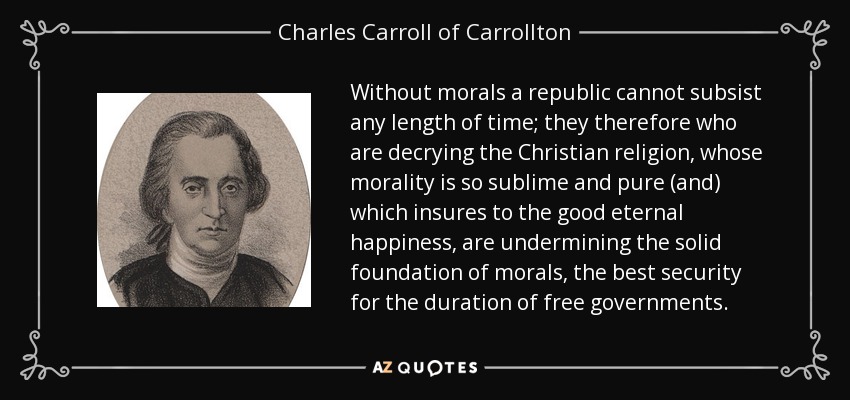
Charles Carroll, Catholic Patriot


As we observe Patriots’ Day in Massachusetts, I keep thinking of the only Catholic signer of the Declaration of Independence, Charles Carroll of Carrollton, Maryland.  

During his first years in school he was joined by his cousin, John Carroll, who would later become the first Archbishop of Baltimore. His Jesuit education continued in philosophy and law in France. Upon his return, he inherited an enormous fortune, but was still barred from entering politics, practicing law or voting due to his Catholicism.  As a result, he assumed the pen name  "First Citizen" and and wrote extensively in the Maryland Gazette.

In his history of the Patriots, Lord Brougham writes that, due to his wealth, Carroll was an unlikely Patriot.  Indeed, of the day on which Carroll signed the Declaration of Independence, Broughman writes:

“He was among the foremost to sign the celebrated declaration of independence. All who did so were believed to have devoted themselves and their families to the Furies. As he set his hand to the instrument, the whisper ran round the hall of Congress, ‘There goes some millions of property!’ And there being many of the same name, when they heard it, said: Nobody will know what Carroll it is,’ as no one wrote more of his name, and one at his elbow remarked, addressing him: ‘You’ll get clear, there are several of that name, they will not know which to take.’ ‘Not so!’ he replied; and instantly added his residence, ‘of Carrollton.’”

Charles Carroll lived longer than any of the other signers of the Declaration of Independence, and is said to have uttered these remarkable words in his last days:

“I have lived to my ninety-sixth year; I have enjoyed continued health; I have been blessed with great wealth, property, and most of the good things which the world can bestow, public approbation, applause; but now what I look back on with the greatest satisfaction to myself is that I have practiced the duties of my religion.”


Seventy five years ago, when Bishop Wright introduced the Serra Club to this fledgling Diocese, there were roughly 320,000 Catholics and 275...