 |
| Bishop McDonnell is pictured with the newly ordained priests of the Diocese of Springfield, including, from right to left, our own Father David Aufiero and Father Rob Miskell. |

04 June 2013
The New Priests of Springfield!

02 June 2013
First Mass of Father Rob Miskell
 |
| Saint Margaret Middleton |
Doesn’t that sound good! Father Miskell! It sounds so good, Father, because it is so good! And it is good because we need you!
Never have we needed a Father more, a representative of God, our heavenly father, who can care for us, teach us, and sanctify us in the name of Christ Jesus, our great High Priest!
Never have we so needed a man to preach the word of God to us “worthily and wisely,” a man so closely united to Christ that he might offer sacrifice on our behalf for the salvation of the whole world, a man to act in the person of Christ for us.
And look at those people out there, Rob! Look at your family! Now they’re supposed to love you and be proud of you. But look at your friends, and your brother seminarians (see the envy) and those who have come to love and admire your pastoral ministry. And just imagine the thousands and tens of thousands who God will place into your care as shepherd and teacher and sanctifier in the decades to come.
Good and holy people to whom you will bring Christ and who will inspire you and strengthen you with God’s grace. People not unlike Margaret Middleton.
Margaret Midleton was born in York, two years before the coronation of Queen Elizabeth I, under whom faithful Catholics like Margaret suffered greatly. The Mass was outlawed and Priests were executed. The Catholic Church, the Holy Eucharist and the Priesthood were banned.
At the age of 18, Margaret married John Clitherow in the Protestant Church and they moved into the family home at 26 Shambles Street. But secretly, three years later, Margaret returned to her Catholic faith and received the Eucharist weekly from an underground priest. John and Margaret had three children, two of whom would eventually become Catholic priests and one a consecrated religious nun.
Margaret was a good wife, and the only two complaints her husband was heard to utter was that “she fasted too much and would not go with him to [the Protestant] church.” In fact, while John was at Church, she would open a secret cupboard containing the vestments and altar breads where there was also a “priest’s hole” or hiding place for Father Mush to crawl into should the authorities arrive.
On March 10 1586, however, the authorities did arrive and Margaret was thrown in prison. She was convicted of treason at Common Hall in York and sentenced to death for ‘harboring and maintaining priests and seminarians, traitors to the Queen’s majesty and her laws.’ Ten days later she was killed, crushed to death by stones.
Yet how Saint Margaret Middleton must be smiling down upon us today, as we celebrate the two great sacraments for which she died: the priesthood and the eucharist.
She died, Father Miskell, because she knew that we needed your hands to join the sacrifices of our lives with the perfect sacrifice offered on the altar of the cross. She died, Father, so that God could call down the Holy Spirit on simple gifts of bread and wine through your hands and transform them into the Body and Blood of his only Son.
So now, Father, you are our priest. You will anoint our sick and bury our dead , you will baptize and marry our children. You will forgive our sins and you will preach the Gospel to us. You, like Father Mush, and Father Campion, and Father Southwell, and Father Walpole, and Father Vianney, and Father DeSales and Father Borromeo will be our priest. And we thank God for it.
For Saint Francis of Assisi used to say that if he met a saint and a priest walking down the road, he would reverently greet the saint, but he would kiss the hands of the priest, for they bring us the Body and Blood of our Lord Jesus Christ
Monsignor James P. Moroney
Rector


01 June 2013
Deacon Jim Boland

Solemn Blessing
from the Rite of Ordination of Deacons
May God who has called you to the service of others in his Church give to you a great zeal for all, especially the poor and the suffering.
May God who has charged you to preach the Gospel of Christ help you to live by his word and thus bear him sincere and fervent witness.
May God who appointed you stewards of his mysteries make you imitators of his Son, Jesus Christ, and ministers of unity and peace in the world.
Holy Communion on Corpus Christi

Today we celebrate the feast of Corpus Christ, the Body and Blood of the Lord. We sometimes say we are going to Mass or to the Eucharist, or, more often, I'm going to Communion.
But why do we call it Communion? With whom do we commune?
As any first communion candidate could tell you, it is Jesus who comes to live in us whenever we say Amen and receive his Body and Blood.
Our Holy Communion is with Jesus in heaven, on earth, and in our hearts.
1. Now Communion with Jesus in heaven is pretty easy to figure out. The Mass is a participation in the heavenly banquet, a communion with the Church in heaven. As Pope John Paul II tells us in his encyclical letter Ecclesia de Eucharistia, “in celebrating the sacrifice of the Lamb, we are united to the heavenly ‘liturgy’ and become part of that great multitude which cries out: ‘Salvation belongs to our God who sits upon the throne, and to the Lamb!’ (Rev 7:10) The Eucharist is truly a glimpse of heaven appearing on earth. It is a glorious ray of the heavenly Jerusalem which pierces the clouds of our history and lights up our journey (EE, no. 19).”
If we look all around us, we should be able to imagine what is really there, though unseen. Angels and Saints rejoicing and sharing in communion with Jesus. Look around you and you will see them: Grandmothers who have gone before us in faith, ancestors who intercede for us from the place of the blessed. This Church, like every celebration of the Sacred Liturgy, is crowded with our invisible friends.
We will get a glimpse of that in just a few minutes when I raise the consecrated Bread and Wine before you and declare: “Behold the Lamb of God...How Blessed are they who are called to the Supper of the Lamb!” Not just this supper, but the heavenly supper and the supper in the upper room…for in the Holy Eucharist all time and space disappear and we are made one with Christ upon the cross and Christ in glory and Christ as he comes to us on that altar.
2. But our Holy Communion is not just with Jesus in heaven. This Communion is also here on earth.The account of the Last Supper in Matthew, Mark, and Luke centers, of course, on the Lord’s gift of the Holy Eucharist. But in the Gospel of John, this Communion is described in the washing of the feet.
To be in communion with the Lord Jesus is not just to eat his body, but to wash the feet of the members of his body, to serve him in the least, the littlest, and the most forgotten. If it is true that whatever we do to the least of them we do to him, then if we are in communion with him, we must be in holy communion with them as well. That’s why Saint Paul says that it is "unworthy" of a parish community to receive Holy Communion and at the same time to ignore the poor (cf. 1 Cor 11:17-22, 27-34, cf. EE, no. 34).
3. And if we are in communion with Jesus in heaven and in the poor man who lives out there on the street, we will also come to recognize him living in our hearts.
For in Holy Communion I came to know Jesus, who was like me in every way but sin---Jesus who understands the pains of my heart, the sorrows that bring tears, and the worries that ache deep inside. In Holy Communion I come to know Jesus, who promises me eternal happiness with him at the heavenly banquet of the Lamb at the end of all time. In Holy Communion I come to know Jesus, who gives me the grace to love, to wash feet, to seek out lost sheep, to pray for those who hate me, to forgive those who hurt me and to love others as he loved me from the wood of the cross.
And that is our Holy Communion, with Jesus who comes down from heaven upon that altar, who makes us like himself in loving all who need us, and who dwells in our hearts.
And how blessed are we who are called to the Supper of the Lamb!
29 May 2013
Father Pignato on Evangelical Catholicism

"A Church that does not go out, sooner or later gets sick in the vitiated atmosphere of her enclosure. It is true also that to a Church that goes out something can happen, as it can to any person who goes out to the street: to have an accident. Given this alternative, I wish to say to you frankly that I prefer a thousand times an injured Church than a sick Church. The typical illness of the shut-in Church is self-reference; to look at herself, to be bent over herself like the woman in the Gospel. It is a kind of narcissism that leads us to spiritual worldliness and to sophisticated clericalism, and then it impedes our experiencing 'the sweet and comforting joy of evangelizing.'"
28 May 2013
Some Reflections on the Priest at Mass
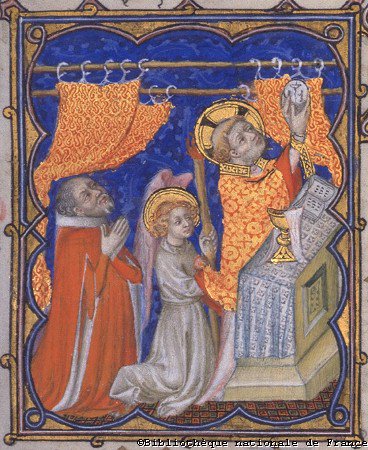
In the spring of 2001, the Congregation for Divine Worship and the Discipline of the Sacraments met in plenary session to consider the major questions before the church in this period of the post-conciliar liturgical renewal. It is significant that among the major issues up for discussion by the Bishop members was the idea of ars celebrandi, a subject addressed at some length by Cardinal George Pell. His Eminence stressed that for the Priest in particular, ars celebrandi is not only a matter of preparation of mind, body, and heart, but also an appreciation of the gestures, the attitude of the body, and the dignity of a humble leadership that is evident to the people in a man who is loving and able to pray the liturgy, able not only to cover himself in sacred vestments, but above all, to be clothed with the Lord Jesus Christ.'
His Eminence's emphasis on the ars celebrandi is an echo of an entirely new paragraph in the General Instruction of the third edition of the Missale Romanum, published the year before the plenarium. Paragraph 93 presents a job description of the Priest at Mass, who because he "possesses within the Church the power of Holy Orders to offer sacrifice in the person of Christ, stands...at the head of the faithful people gathered together here and now, presides over their prayer, proclaims the message of salvation to them, associates the people with himself in the offering of sacrifice through Christ in the Holy Spirit to God the Father, gives his brothers and sisters the Bread of eternal life, and partakes of it with them." What is particularly interesting, however, is that this job description is followed by a performance review, perhaps one of the most succinct and challenging statements ever written of who the Priest is supposed to be at Mass: "When he celebrates the Eucharist, therefore, he must serve God and the people with dignity and humility, and by his bearing and by the way he says the divine words he must convey to the faithful the living presence of Christ." (General Instruction of the Roman Missal, no. 93)
Is there any more important agenda in the renewal of the liturgical reform of the Second Vatican Council than fostering from the inside out a true appreciation of this ars celebrandi in the heart of every Priest? An ars celebrandi which is not so much a matter of mastering skills, as conforming my heart to the Lord into whose Priesthood I have been ordained, and with whom I seek to join his holy people?
Sacrosanctum Concilium
The Council Fathers first articulated this truth in the oft-quoted fourteenth paragraph of the Conciliar Constitution Sacrosanctum concilium. Have you ever listened to a talk on the Sacred Liturgy which has not recalled that the "full and active participation by all the people is the aim to be considered before all else..."? However, seldom is the paragraph quoted in context. For this seminal challenge is immediately followed by the strikingly blunt assertion that it "would be futile to entertain any hopes of realizing this unless the pastors themselves, in the first place, become thoroughly imbued with the spirit and power of the liturgy" (SC, no. 14)
For priest are the primary agents of the liturgical reform. The success or failure of the conciliar vision is largely in their hands. And success must always begin with a renewal of their priestly hearts.
Internalization
Our Holy Father, Pope Benedict XVI, has frequently returned to this theme, as he did in a conversation with diocesan priests from Albano, Italy on August 21, 2006. The ars celebrandi, he insisted, first demands that "the priest enter truly into [the dialog between God and man, which is at the heart of the sacred liturgy]. Announcing the Word, he must feel himself in colloquy with God."
Of course, we might be tempted to reply. Every priest knows that when he stands at the altar he is in dialog with God. But does he? Is the focus of the average American priest at mass more on Christ or on the performative and relational dimensions of the ritual he has been taught to enact? Are the individual relational aspects of his art sometimes prior to and obstructive of the divine dialogue into which he is called to lead us?
"He is in a dialog with God," the Holy Father reminds us, precisely "because the texts of the Holy Mass are not theatrical lines or some such - they are prayers, thanks to which, together with the congregation, I as priest talk to God."
Pope Benedict XVI then introduces us to the mystagogical dimension of the ars celebrandi, recalling how the Rule of Saint Benedict describes the monk's praying of the Psalms as "Mens concordet voci." So too with all the words and rites of the Sacred Liturgy, they begin with an enacted or spoken prayer, and only then invite us to enter in to their meaning, to join the dialog with God.
Such a mystagogical approach to the Liturgy, the Holy Father suggests, demands that we approach the Sacred Mysteries as "a continuation of a permanent growth in adoration and in announcing the Gospel... so that we might "enter join our minds and hearts to the voice of the Church."
Thus do we "transform our "I" into the "we' of the Church, enriching and amplifying this "I", praying with the Church, with the words of the Church, and being truly in colloquy with God."
Notice the Holy Father's constant insistence on internalization as the first prerequisite for an authentic Priestly ars celebrandi. A few years ago, I was invited by the Cathedral Rectors' Association to address them on how to improve cathedral Liturgy. While they were probably expecting a dissertation on the fine points of the latest rubrical disputes, that's not what they got. For to make better Priest celebrants, I suggested to them, you need to encourage Priests to be holier: to seek after sanctity, to long for prayer, to rejoice in virtue, to be conformed more and more to Christ. That is the secret of the ars celebrandi: obedience, authentitcity, humility, and love for the sacred rites and texts are by-products of a life lived in close communion with Christ. It's the same secret known by Chaucer in the Parson's tale: "Christe's lore and his apostle twelve he taught...but first he followed it himself."
Internalization and John Paul II
While the recently promulgated third edition of the Roman Missal speaks convincingly of the priest's responsibility to adapt the sacred liturgy to the genius and culture of each individual gathered assembly, we perhaps sometimes forget that, in the words of Cardinal Francis Arinze, such exterior engagement is drawn from and is based upon a deep and interior relationship with Christ. "On the one hand, he cannot isolate himself from the presence of the people. On the other hand he should not become a showman who projects himself." "The liturgy" he" stressed, "is not primarily what we make but what we receive in faith." (11th General Synod of Bishops, session eight)
Nor is this theme unique to the present pontificate. It was Pope John Paul II who encouraged Priests never to forget the "intimate bond between the Priest's spiritual life and the exercise of his ministry" (Pastores Dabo Vobis, no. 24). And the same Pontiff who issued perhaps the most challenging words of the first forty years of the liturgical reform, when her reminded the Bishops of the United States in the course of their ad limina visit that "prayer for the needs of the Church and the individual faithful is so important that serious thought should be given to reorganizing priestly and parish life to ensure that priests have time to devote to this essential task, individually and in common. Liturgical and personal prayer, not the tasks of management, must define the rhythms of a Priest's life, even in the busiest of parishes." (May 21, 1998 Pope John Paul H met with bishops from Michigan and Ohio during their ad limina visit to the Holy See)
Would that we would heed those prescient words!
An American Disability
But why don't we? Is it because we share in an American obsession with doing over being, with relating over reflecting, with performance over substance, with pleasure over patience, with satisfaction over truth? Is it because we fear the silent, the reflective, the quiet presence of God in the heart of a listening child?
We live in a society which loves to "get things done." We are great "doers." Thus we are able to embrace with gusto the aspect of the liturgical reform which called us to "do more." But we're not so good at reflecting, at meditating on the mysteries we celebrate. Without such meditation, without a life of reflective prayer, we will never be able to celebrate the Mass fully, consciously or actually.
The Presentation of the Instrumenta
How, then, can a priest approach the sacred mysteries, speak the sacred texts, or give his body, mind, and voice over to the immemorial rights unless he is willing to seek the secret of this mystery in the silent beauty of the God who whispers to his heart? If the Priest is not passionately in love with Christ and the sacred rights which join us to his Sacred Heart, if he is unwilling or unable to empty his heart in the same way that Christ the lead for him from across, then how can he take up the cup of salvation and call upon the name of the lord?
For the secret, you see, is in three little words spoken to the priest when the chalice filled with wine and that paten with bread are first placed into his hands: agnosce, imitare, conforma: know what you are doing, imitate what you touch, and conform your life to the cross. I suggest that these mandates describes a radically new and challenging way of relating to the liturgy and plot a certain course for growing in the ars celebrandi.
Accept from the holy people of God the gifts to be offered to him.
Know what you are doing, and imitate the mystery you celebrate:
model your life on the mystery of the Lord's cross.
Agnosce: Know What You Are Doing
I wonder whether in the thirty years since the reform of the liturgy was first begun, whether any talk given by any liturgist has failed to quote that famous line from number 14 of Sacrosanctum Concilium:
In the restoration and promotion of the sacred liturgy, this full and active
participation by all the people is the aim to be considered before all else;
But seldom is the whole sentence quoted. And I suggest that, especially for our purposes, the rest of the sentence is essential:
for it is the primary and indispensable source from which the faithful are to
derive the true Christian spirit;
And there’s yet a third part of the sentence:
and therefore pastors of souls must zealously strive (LATIN) to achieve it, by means of the necessary instruction, in all their pastoral work.
How do we achieve such participation? By forming Committees? No. By re-arranging furniture? No. “by means of the necessary instruction” and the primary agents of that “full, conscious and active participation” are you and me. And not me as liturgist, either. Me as priest.
The Council fathers clearly intended that the primary agents of the liturgical reform would be priests, who in their ministry as pastors of souls would accomplish such participation from the inside out. Pastors, primary business is as physicians of souls, not technicians whose role is the re-editing of scripts.
But then the Council Fathers became even more explicit, even bold in their predication.
Yet it would be futile to entertain any hopes of realizing this unlessß the
pastors themselves, in the first place, become thoroughly imbued with the
spirit and power of the liturgy, and undertake to give instruction about it. A
prime need, therefore, is that attention be directed, first of all, to the
liturgical instruction of the clergy.
To avoid a futile liturgical reform, two things must happen to you and me as priests:
We must first “become thoroughly imbued with the spirit and power of the liturgy” and only then can we undertake to give instruction about it. This is not a mere matter of reading books on liturgy, or even of studying the theological and ecclesiological dimensions of liturgical texts and rites. This is a matter of becoming thoroughly imbued with the spirit and power behind the liturgical reform and the spirit and power which has always awaited us at in the rites and prayers of the liturgy.
In order to teach prayer, however, we must be men of prayer. We must pray the prayer of the Church in the morning, noon and evening. We must not only read but agonize over the meaning of the scriptures for his own daily life. We must pray for the gift of the Holy Spirit to give him strength, life and new insights into what God wants for him.
For the priest who prays each day is new and alive and exciting and a wonderful gift from God. For priest who prays nothing is an insurmountable obstacle, nothing a paralyzing fear, no thing to great to conquer. If we are really praying, if we are really striving for holiness, we will make others holy just by being with them. Or, as Chaucer wrote of the good parson,
Christe's lore and his apostles twelve he taught,
but first he followed it himself.
Knowledge of the Liturgy
So liturgical formation must clearly begin with us, and it must begin from the inside out, with prayer. But, as the second clause of that sentence from Sacrosanctum Concilium xxx states, it must also involve a certain instruction. And in order to accomplish instruction we must first be instructed.
In the course of a given year I am profiled in my work for the US Episcopal Conference to speak with close to a score of presbyterates like yourselves on a variety of topics liturgical. One of the most recent topics has been a revisiting of the 1989 Order of Christian Funerals. 1989Χtwo years ago, this book became the only approved way for Catholic priests to celebrate the rites of Christian death and burial. Yet each time I begin a workshop with a presbyterate I begin with a question. How many of you own a copy of the Order of Christian Funerals? And each time I am depressed to realize that a minimum of 5% and on one occasion as much as 40% of a presbyterate did not even own the book!
Such a situation is scandalous. But equally as scandalous is the fact that many priests, while possessing a copy of the liturgical books (it’s a good start!) Have never read the introductions, the rubrics or the full course of optional prayers provided by the revised liturgical books. Do we always know what we are doing in the liturgy? Do we know the rites we celebrate? Do we read the introductions to the liturgical books? Do we pray the prayers and make them our own? The first step in opening ourselves to the wonderfully transforming and sanctifying power of the liturgy is to know the rites we celebrate. Such a discovery comes by way of hard work and study, searching for Christ in liturgical prayer.
Nor is knowledge of the liturgy simply a matter of comprehending liturgical law or the words of the liturgical books, as necessary as such an understanding may be. As the Council Fathers reminded us, something more is needed. We must know the liturgy “by heart.” We must break open the euchology of our rite and allow it to form us. We must pray the Sunday collect in the private of our room before proclaiming it in the gathered assembly. Only when they has become a part of the fiber of our being and the rhythm of our day will the prayers of the liturgy begin to transform and consecrate us from deep within our being. And only when they have transformed us, will they transform the Church so badly in need of “that full conscious and active participation” which is demanded by the very nature of the liturgy.
For, as the Council Fathers reminded us”...in order that the liturgy may be able to produce its full effects, it is necessary that the faithful come to it with proper dispositions, that their minds should be attuned to their voices, and that they should cooperate with divine grace lest they receive it in vain (28) . Pastors of souls must therefore realize that, when the liturgy is celebrated, something more is required than the mere observation of the laws governing valid and licit celebration; it is their duty also to ensure that the faithful take part fully aware of what they are doing, actively engaged in the rite, and enriched by its effects.”
Notice the phrase is “something more...than valid and licit celebration.” The presumption here is that the liturgy is celebrated in full accordance with the laws of the Roman rite. As one liturgist is wont to say, people have a right to the Roman Rite. A rite whose immemorial liturgy is always far more appropriate than the private musings or personal adaptations made by a charismatically inspired individual, even if he is a priest. Or, as SSC 22.3 put it so well, “no other person, even if he be a priest, may add, remove, or change anything in the liturgy on his own authority.”
But something more is demanded, even beyond the valid and licit celebration of the liturgy. And that something more is that minds be attuned to voices and that those voices be in tune with divine grace as dispensed by the Church and her sacred liturgy. Listen to Ignatius of Antioch:
At worship, he says. you must be like the string of a lyre, each in harmony with the bishops. Hence it is that in the harmony of your minds and hearts Jesus Christ is hymned. Make of yourselves a choir, so that with one voice and one mind, taking the keynote of God, you may sing in unison with one voice through Jesus Christ to the Father, and He may hear you and recognize you...as members of his Son.
That is the Church’s vision of full, conscious and active participation in the liturgy which can be achieved only by good, holy and learned priests who sing God’s praise in tune with the Church.
The first requirement of the priest who seeks to conform himself to Christ in celebrating the Sacred Liturgy is to faithfully, obediently, and authentically seek to sing God's praise in tune with the Church. This is the message of Redemptionis sacramentum, of the extraordinary efforts of the Bishops of this country to promote a faithful implementation of the General Instruction of the Roman Missal and the continuing efforts of the Bishops' Committee and the Liturgy in this regard.
Imitare: Imitate the Mystery You Celebrate
We are called to be transformed by the sacred mysteries we celebrate, to imitate the very mysteries we touch. Such change, however, can only be the result of a profound appreciation of the Scriptures, a typological mystagogy which enters deeply into the language and the life of the Sacred Liturgy and its rites and texts.
When a Priest picks up the Chalice at Mass, how can this change him? If he sees this Sacred Vessel simply as a cup to be raised to prescribed heights and over which he must sing or say prescribed formulas, I suggest that not much will happen to him. However,
- if in the quiet of his room late at night he meditates on the cup of suffering which the Lord prayed would pass him by (Mt.26.39); or of the "cup of blessing" of which St. Paul writes.
- If each day, in the name of Jesus, he offers to those in need that "cup of cold water" of which our Savior spoke (Mk.9.4)
- If before the Blessed Sacrament he recalls the life-giving "cup of the new and everlasting covenant" (Lk.22.20)
- If when he looks upon Christ on the cross he see a chalice, emptied that we might be filled, "obedient unto death, death on a cross" (Phil.2.7-8).
- If the Priest come to deeply understands the Chalice that he holds in his hands, then he too will become a chalice: ready to be emptied, ready like Christ, to learn through obedience to the will of the Father. (Heb.5.8 )
A true understanding of what it means to take that Sacred Chalice in my hands gives me the grace to accept the kind of suffering I would instinctively shun, even as Jesus did in the garden (Mk.14.36). For most assuredly, in our own Gethsemanes we will find this same chalice offered to us over and over, until we have drunk it fully and thereby been "conformed to the image" (Rom.8.29) of Christ. Each day, then, as we raise that Chalice at Mass, we can make our own the words of Psalm 116, so appropriately incorporated into the offertory of the old Dominican rite:
What return shall I make to the Lord for all the good things he has done for me The cup of salvation I will take up, and I will call upon the name of the Lord.
Becoming Christ’s Word
Recall, is you will, the presentation of the instrumenta at another ordination, one which every priest comes to his second ordination already in his possession. And I would suggestion that the Church’s demand that he become the mysteries he touches in the chalice and cup applies equally as well to the Book of Gospels which he received with the words:”believe what you read, teach what you believe and practice what you teach.” Indeed that presentation formula is as good a description as any of the way in which the priest can be grafted on to the Word made flesh.
We also touch this Gospel with our lips each time it is proclaimed. For in the Word of God Christ is present and active in his church. But there’s something more, as we hear from the introduction to the new Lectionary for Mass:
In the celebration of the liturgy the word of God is not voiced in only one way9 nor does it always stir the hearts of the hearers with the same power. Always, however, Christ is present in his word;10 as he carries out the mystery of salvation, he sanctifies humanity and offers the Father perfect worship.11
Christ is at work when the gospel is proclaimed In a world so desperately in need of hope, he is hope made fleshΒthe ultimate in good news. And it is the proclamation of the word we proclamation of this word in the assembly which is the prototype for the proclamation the word of God should play in our everyday life.
By rite and by life, then, the Priest is called to conform his life to him in whose image he acts ay Mass. The priest who seeks to conform himself to the paschal Christ must ever pray for the gifts of humility and obedience. Obedience to the prayer of the Church, obedience to the word of God which calls him to die to himself in the model of Christ, and obedience to the Sacred Euchology and Sacred rites he prays.
Such an obedience makes of the priest presiding at the liturgy a humble servant.
He is not a host, like Oprah Winfrey: his success is not gauged by how entertained people feel. He is not a performer: his success is not gauged by how much he stirs human emotions. He is not a politician: his success is not gauged by how popular he is.
He is a servant-Priest in the likeness of Christ Jesus, whose success is gauged by how transparently he shows forth Christ, how effectively he leads people to Christ and how obediently he dies to himself so that it is no longer he who lives but Christ Jesus who lives in him, no longer he who is seen, but Christ Jesus who is alive and acting and present to his Church through him.
Conforma: Conform Your Life to the Lord’s Cross
This third imperative, I would suggest, is nothing more than a restating of the first two. For if we know what we are doing,
if by prayer and study and sweat and agony we embrace the liturgical heritage which is ours in the sacred liturgy;
if we turn our lives into a cup of thanksgiving, poured out to the world,
if we conform ourselves to the body of the Lord who has been broken to make us whole;
if we proclaim the Word made flesh in season and out;
if our lives are conformed to the mysteries we celebrate,
then the liturgies which we celebrate will be grafted onto the one great heavenly liturgy, the Pasch of the Lamb who takes away the sins of the world. And that is what holiness is all about.
The idea here is that the priest, in order to preside in the person of Christ at the liturgy, must conform himself to the cross. At the heart of the mystery of the cross is the radical obedience of Christ, an “obedience unto death, death on a cross.”
The priest presider who thus conforms himself to the cross will be characterized by obedience. Obedience to the prayer of the Church, obedience to the word of God which calls him to die to himself in the model of Christ, and obedience to the euchology and rites he prays.
Such an obedience makes of the priest presiding at liturgy a humble servant. He is not a host, like Oprah WinfreyΧhis success is not gauged by how “entertained” people feel. He is not a performer like xxxΧhis success is not gauged by how much he stirs human emotions. He is not a politician like Bill ClintonΧhis success is not gauged by how popular he is. He is a servant priest in the likeness of Christ Jesus, whose success is gauged by how transparently he shows forth Christ, how effectively he leads people to Christ and how obediently he dies to himself so that it is no longer he who lives but Christ Jesus who lives in him, no longer he who is seen, but Christ Jesus who is alive and acting and present to his Church through him.
All of which brings us full circle to what the Church asks of the priest when he celebrates the Sacred Liturgy. Like the words of the Council Fathers with which I began, the homily provided for the bishop in the rite for the ordination of priests begins with a description of the unique role the priest is given by God in the Church and in her liturgy.
In sacred ordination, there is conferred on priests that sacrament through which “by the anointing of the Holy Spirit they are sealed with a special character and so configured to Christ as priest that they are strengthened to act in the person of Christ the Head.
I suggest that a this sentence wonderfully uncovers a description of the distinctive character of priestly ministry and how it differs from every other ministry in the Church and in the liturgy. The Council of Trent made clear and the fathers of the Second Vatican Council reaffirmed that the one chosen to preside at Sacred Liturgy does so in the person of Christ and that such an order is transmitted from the Holy Spirit through the successors of the apostles, for it is not who choose God, but he who chose us. The use of the typically Thomistic vocabulary of conferral of the sacrament of orders on the priest so that he might be sealed with a sacred character and configures to Christ describes the way in which the priest is prepared for Sacred worship.
This is the vocation to which we have been called, the order into which the Church has ordained us. It is a responsibility to be taken with all the seriousness of which we are a capable. For we have been called to nothing less than to be the door through which God enters the lives of his people, the portal through which their prayers come before him.
It is a great vocation of which none of us are worthy. But the fact remains that Christ has called us. May we strive each day to re-hear the words spoken at our ordination from the ordination homily I referenced above. May we hear the words spoken by the bishop and coming from Christ and his Church:
When joining men and women to the people of God through baptism, and remitting their sins in the name of Christ and the Church through the sacrament of Penance; when supporting the sick with holy oil and celebrating sacred rites; when you praise with thanksgiving and offer prayers throughout the hours of the day not only for the people of God but for the whole world as well,
be mindful that you are taken from among the people and set apart for the people in those things which pertain to God. Therefore, with true love and unfailing joy carry out the office of Christ the Priest, attending not to your own concerns but to those of Christ Jesus.
27 May 2013
Memorial Day Prayers

The following prayer from the Roman Missal is for deceased relatives, friends, and benefactors.
O God,
giver of pardon and loving author of our salvation,
grant, we pray you, in your mercy,
that, through the intercession
of Blessed Mary, ever-Virgin, and all your Saints,
the members, friends, and benefactors of our community,
who have passed from this world,
may attain a share in eternal happiness.
Through our Lord Jesus Christ, your Son,
who lives and reigns with you in the unity of the Holy Spirit,
one God, for ever and ever.
Subscribe to:
Posts (Atom)